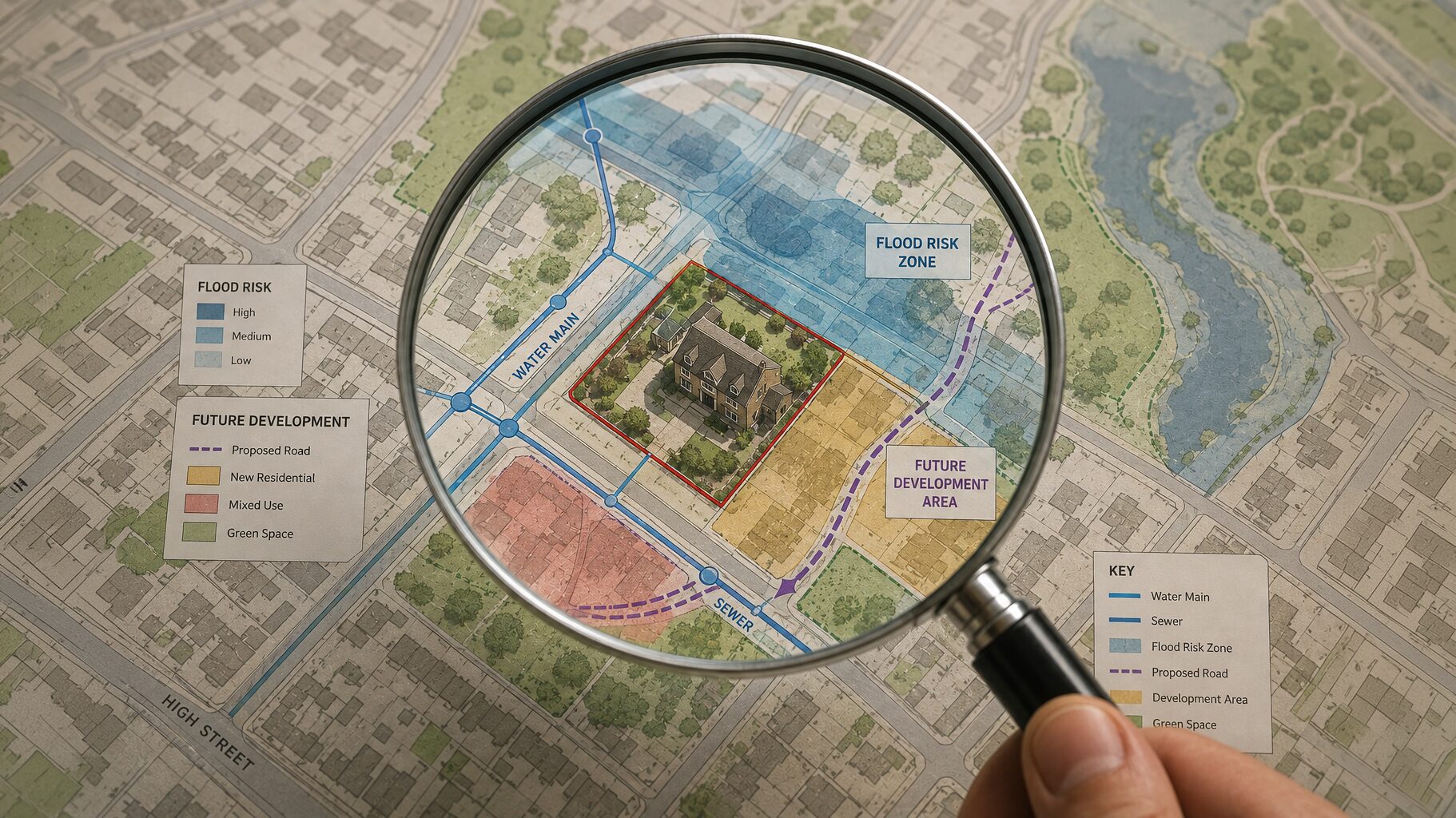
Property searches are an important part of the conveyancing process when buying a house or flat.
They are checks carried out by your solicitor to identify legal, environmental, drainage, planning and other issues that may affect the property. Some issues will not be obvious from viewing the property, reading the estate agent’s particulars or even carrying out a survey.
The three core searches usually ordered during a residential property purchase are:
| Search | What it checks | Why it matters |
| Local Authority Search | Planning, building regulations, highways, enforcement action, conservation areas, listed building status and local land charges | Reveals council-held information that could affect how the property can be used, altered, insured or sold |
| Environmental Search | Flood risk, contaminated land, ground stability and other environmental risks | Helps identify issues that may affect value, insurance, safety or future liability |
| Drainage and Water Search | Mains water, public sewers, water authority and sewer location | Important for future works, extensions, maintenance and connection to services |
If you are buying with a mortgage, your lender will usually require searches. Cash buyers do not have to obtain searches, but deciding not to do so can expose them to risks that may affect the property’s value, its use or future marketability. It makes little sense not to undertake searches given their relative low cost.
What is a Local Authority Search?
A Local Authority Search contains information held by the local council and, where applicable, local land charges information held by HM Land Registry.
It may reveal matters such as:
- planning history and planning policies;
- building regulations history;
- road, rail or transport schemes;
- major infrastructure projects;
- council enforcement action;
- financial charges or notices affecting the property;
- conservation area status;
- listed building status;
- tree preservation orders.
This search is particularly important because it can identify legal and practical issues that may affect the use and enjoyment of the property. For example, it may show whether works have been carried out without appropriate approvals, whether the property is subject to restrictions, or whether future alterations may be limited.
What is an Environmental Search?
An Environmental Search checks for environmental risks that may affect the property.
This can include:
- flooding;
- contaminated land;
- ground stability;
- nearby landfill or historic industrial use;
- other environmental factors relevant to the location.
This matters because environmental issues can affect the property’s value, insurance position and future saleability.
For example, if a property is affected by contaminated land, there may be questions around liability for remediation. Contamination may arise from historic industrial use, unauthorised dumping or other previous uses of the land.
Flood risk can also be significant. A high flood risk may affect buildings insurance premiums, the availability of flood cover, the buyer’s willingness to proceed and the lender’s requirements.
What is a Drainage and Water Search?
A Drainage and Water Search provides information about the property’s water and sewerage arrangements.
It will usually confirm:
- whether the property is connected to mains water;
- whether it is connected to public sewers;
- who the local water authority is;
- whether any public sewers or water mains are within the property boundary.
This can be important if the buyer intends to extend or alter the property. The presence of public sewers within the boundary may affect where building works can take place and whether further consents or build-over agreements are required.
It can also help identify maintenance responsibilities and practical issues relating to drainage, access and services.
Do cash buyers need property searches?
Cash buyers can choose not to undertake property searches, however, that does not mean searches are unnecessary. A cash buyer who proceeds without searches may not discover issues until after completion. Those issues could affect how the property can be used, whether alterations are possible, whether insurance is available, or whether the property is easy to sell in the future.
For example, a cash buyer may still want to know whether:
- unauthorised works have been made to a listed building;
- previous works had building regulations approval;
- the property has flood or contamination risk;
- the road serving the property is not publicly maintained;
- All development taxes (community infrastructure levies) have been settled.
Searches are therefore not just a lender requirement. They are a buyer protection tool.
What additional property searches might be needed?
The three core searches are not always the only searches recommended.
Depending on the property’s location and circumstances, your solicitor may recommend additional searches. These may include:
- coal mining search;
- chancel repair search;
- planning or development assessment search;
- commons registration search;
- HS2 or infrastructure search.
For example, a coal mining search may be appropriate if the property is in a former coal mining area. A development assessment search may be useful where a buyer wants to understand the likelihood of nearby development or planning activity.
The right searches will depend on the property, its location and the buyer’s plans.
How much do property searches cost?
The cost of property searches varies depending on the local authority, property location, search provider and search pack selected.
As a broad guide, the three core searches in London are often in the region of £300 to £500, although this can vary. A development assessment search may cost around £160. A property search platform or agent may reduce the overall cost, sometimes to around £250 to £300, although turnaround times can vary.
Buyers should treat search costs as part of the normal cost of buying a property. They can feel like an additional expense at the outset, but they may reveal issues that would be much more expensive to resolve later.
How long do property searches take?
Search timings vary.
Environmental and Drainage and Water Searches are often returned quickly, sometimes on the same day. Local Authority Searches can take longer, particularly where records are not fully electronic or where a personal search agent is used.
As a broad guide, a Local Authority Search through a property search platform or agent may take around three weeks, while a direct search in London may often be returned within around one week where the council has electronic records.
Search delays can affect the overall conveyancing timetable. Buyers working towards a specific exchange or completion date should therefore ask their solicitor early about expected search turnaround times.
Why do property searches matter?
Property searches help buyers make informed decisions before exchange of contracts.
They can reveal issues that affect:
- value;
- insurance;
- lender requirements;
- planned alterations;
- future development potential;
- marketability;
- safety;
- legal compliance;
Once contracts are exchanged, the buyer is legally committed to proceed. It is therefore important that search results are reviewed and any concerns dealt with before that point.
How Quastels can help
Please contact Quastels if you are buying a residential property and would like advice on the purchase process.