By Jayesh Jethwa, Partner and Head of Corporate and Private Immigration at Quastels. Jayesh is recognised by The Legal 500 within Quastels’ Hospitality and Leisure offering and advises restaurants, hotels and other operators across the sector on sponsor licensing, right to work compliance and business immigration risk.
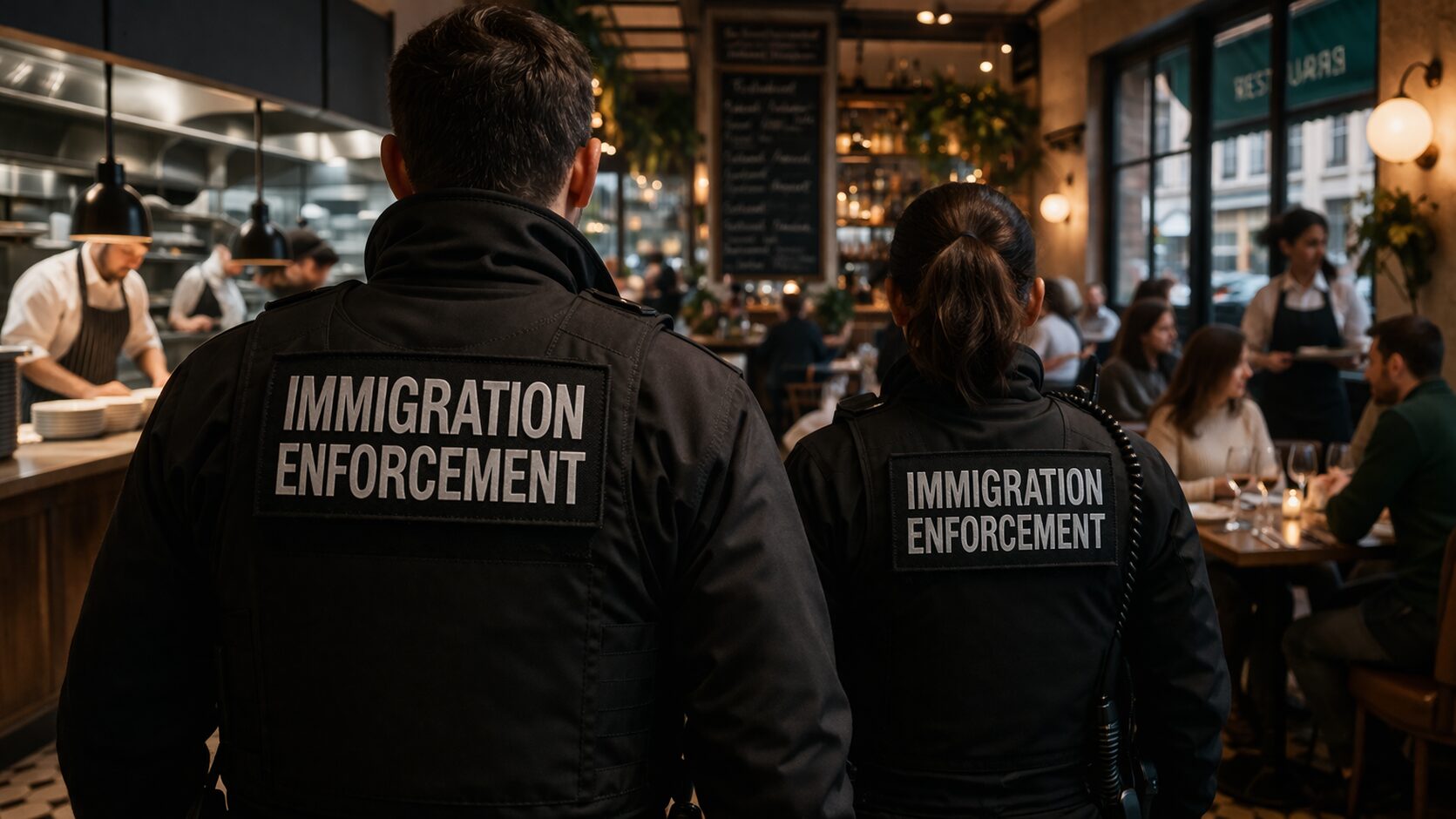
The recent reporting on immigration raids in restaurants has resonated because it describes something many hospitality operators already sense: illegal working enforcement is no longer a peripheral compliance issue. It is part of the operating climate of the sector. The Guardian article reports concern among restaurant owners and workers that raids have been experienced as intimidating and, at times, indiscriminate, while the Home Office maintains that its operations are intelligence-led and not based on race or ethnicity. Without suggesting any precise equivalence of legal regime, some hospitality operators will inevitably view this as closer in style to the kind of visible workplace immigration enforcement more commonly associated with ICE in the United States than to ordinary compliance activity. The politics of that comparison will be contested. The legal and commercial point is not. For restaurants, cafés, takeaways and hotels, immigration enforcement now sits materially closer to ordinary business risk than many operators have historically assumed.
The official figures bear that out. The Home Office’s March 2026 sector release records 12.832 illegal working visits in 2025 and 9,008 arrests arising from those visits. Of those visits, 3,559 took place in restaurants, takeaways, and cafés, the single largest sector category listed. The same release records 2,438 civil penalties issued to employers in 2025, with gross exposure of more than £130 million. Hospitality is not incidental to the current enforcement picture. It is one of its principal sites.
For serious operators, that should change the frame of the discussion. The relevant question is no longer whether enforcement is visible. It plainly is. The relevant question is whether the business would withstand scrutiny if scrutiny arrived tomorrow, during service, with incomplete information, anxious staff and a management team forced to explain its systems in real time. That is the point at which immigration law stops being an administrative topic and becomes a question of operational resilience.
Enforcement in hospitality is not only about fines
The statutory framework is familiar enough. Where an employer is found to have employed a person who does not have the right to work, and the employer cannot establish a statutory excuse, the Home Office may impose a civil penalty of up to £60,000 per illegal worker. Where the employer knew, or had reasonable cause to believe, that the worker was disqualified from working by reason of their immigration status, criminal liability may also arise. GOV.UK also states that the employer’s details may be published and that the penalty notice itself carries a 28-day response period.
But for restaurants and hotels, the real damage is often broader than the penalty notice. A raid can disrupt trading hours, alarm customers, unsettle managers, expose weaknesses in site-level oversight, destabilise relationships with landlords and lenders, and produce reputational harm entirely disproportionate to the duration of the visit itself. In a sector built on service, continuity and confidence, the commercial consequences of enforcement are rarely confined to the formal legal sanction.
That wider picture is one reason the current moment should be treated with seriousness. Illegal working enforcement in hospitality is not simply an immigration problem. It is a governance problem, a staffing problem, and in some cases, a brand problem.
The law is technical, and hospitality businesses are often exposed by inconsistency rather than bad faith
The present right to work regime is not conceptually obscure, but it is exacting in application. The Home Office employer guidance requires an employer to carry out one of the prescribed checks before employment begins and to retain the evidence properly in order to establish a statutory excuse. The current guidance, updated in 2025, also reflects the increasing importance of digital status and confirms that expired physical BRPs are not acceptable evidence of right to work.
In practice, hospitality businesses are rarely exposed because they have done nothing at all. They are exposed because one part of the business has done enough and another has not. One site follows the online checking process correctly. Another relies on a screenshot sent by text. One manager diarises follow-up checks for a time-limited worker. Another assumes that because the individual has proved reliable, the original position must still be in order. One group company centralises files. Another leaves them scattered across local inboxes and site managers’ phones.
The sector itself explains part of the difficulty. Staffing can be fast-moving. Recruitment can be decentralised. Weekend or evening hiring decisions are sometimes made under operational pressure. Group structures may leave legal employment in one company and day-to-day supervision in another. Sponsorship may sit with head office while local oversight sits elsewhere. None of that is inherently improper. All of it can create precisely the sort of fragmentation in which compliance becomes performative rather than real.
The law does not allow much room for performative compliance. It asks a narrower question: were the prescribed checks done, were they done in time, were the retained records sufficient, and can they now be produced.
Sponsor licence exposure is part of the same risk landscape
For hospitality operators who hold sponsor licences, the issue is not only illegal working viability. It is also licence integrity.
The Home Office announced in September 2025 that 1,948 sponsor licences were revoked between July 2024 and June 2025, more than double the previous 12 months. The reasons highlighted publicly included underpayment, failure to provide the jobs promised, and conduct said to facilitate abuse of the system. Whatever the variations between cases, the broader message is clear enough: sponsor compliance and illegal working enforcement are no longer separate conversations. They now sit within the same field of regulatory scrutiny.
In hospitality, that matters especially because sponsored recruitment is often operationally significant. Where a restaurant group, hotel business or leisure operator depends in part on sponsored workers, a compliance failure can do more than generate a penalty. It can unsettle the employer’s ability to recruit, to retain sponsored staff, and to reassure the Home Office that the organisation remains a sponsor fit to be trusted with sponsorship. A business that treats civil penalty risk and sponsor licence risk as unrelated is likely to discover, too late, that the Home Office does not.
The practical question is not whether enforcement is fair in the abstract. It is whether the business is ready for it in fact
There is no difficulty in acknowledging that the language surrounding enforcement can be politically charged. But operators need something more useful than rhetoric. They need to know what scrutiny would reveal if it happened now.
That enquiry is, in truth, more disciplined than many assume. It includes at least the following:
- Can the business show a consistent right to work checking process across all sites and legal entities.
- Can it produce its right to work records without delay.
- Can it identify who is responsible for follow-up checks and whether those checks have actually occurred.
- Can it show that sponsored workers are being employed in accordance with the roles, salaries and working patterns that sponsorship presupposes.
- Can it explain who, within the business, would manage a visit, engage with officers, preserve documents and seek legal advice.
The businesses best placed to absorb scrutiny are not always the largest operators or the most sophisticated on paper. They are usually the ones that have tested their own systems before enforcement tests them instead.
What restaurants and hotels should be doing now
The sensible response for the sector is not alarm. It is preparation.
That means reviewing right to work systems at site level rather than assuming that head office policy alone is enough. It means checking that online right to work checks are actually being done where required, that files are centrally retrievable, and that time-limited permissions are diarised and followed up. It means ensuring that sponsor licence records, salary records and Appendix D materials are in order. It means knowing which members of management understand the legal position and which only assume that someone else does.
For some operators, this will require no more than tightening systems and retraining managers. For others, especially those with decentralised operations or recent growth, it may require a more searching internal audit. In a sector where margins are often tight and management bandwidth is finite, that can feel unwelcome. It is still less expensive than trying to reconstruct compliance in the aftermath of a raid or civil penalty notice.
This is now a sector issue, not an edge case
The significance of the current enforcement climate lies in repetition. Hospitality is appearing in the data too often for anyone to treat this as marginal. Where a sector accounts for the largest category of illegal working visits in the Home Office’s own breakdown, the prudent course is not to hope the problem belongs elsewhere. It is to assume the sector is in view and to act accordingly.
That is the practical lesson to draw from the recent reporting. The Guardian piece may read as a story about anxiety, politics or enforcement style. For hospitality businesses, it should also be read as something more prosaic and more urgent: a reminder than immigration compliance has become part of the discipline of running the business well.
Frequently asked questions
Yes. The Home Office carries out illegal working visits across sectors, and its published sector data for 2025 shows that restaurants, takeaways and cafés accounted for the largest category of illegal working visits.
The employer may face a civil penalty of up to £60,000 per illegal worker if it cannot establish a statutory excuse. In more serious cases, including where the employer knew or had reasonable cause to believe that the person did not have the right to work, criminal liability may arise.
Yes. Sponsor compliance and illegal working enforcement increasingly sit within the same compliance landscape. The Home Office reported 1,948 sponsor licence revocations between July 2024 and June 2025.
It is the employer’s defence to civil penalty liability, established only where the prescribed right to work checks were carried out properly before employment began and the required records were retained correctly.
What should a hospitality business do after an enforcement visit?
It should immediately secure its right to work and recruitment records, establish the chronology of what occurred, identify which workers are affected, review sponsor licence implications if relevant, and take legal advice before assumptions harden into a response strategy.
For restaurants, hotels and hospitality operators, immigration compliance is increasingly an issue of operational resilience as much as legal risk. Where the position is already live, or where a business would benefit from testing its systems before enforcement does it instead, early legal review is often worthwhile.
To discuss the contents of this article, please contact Jayesh Jethwa or our wider Immigration team.