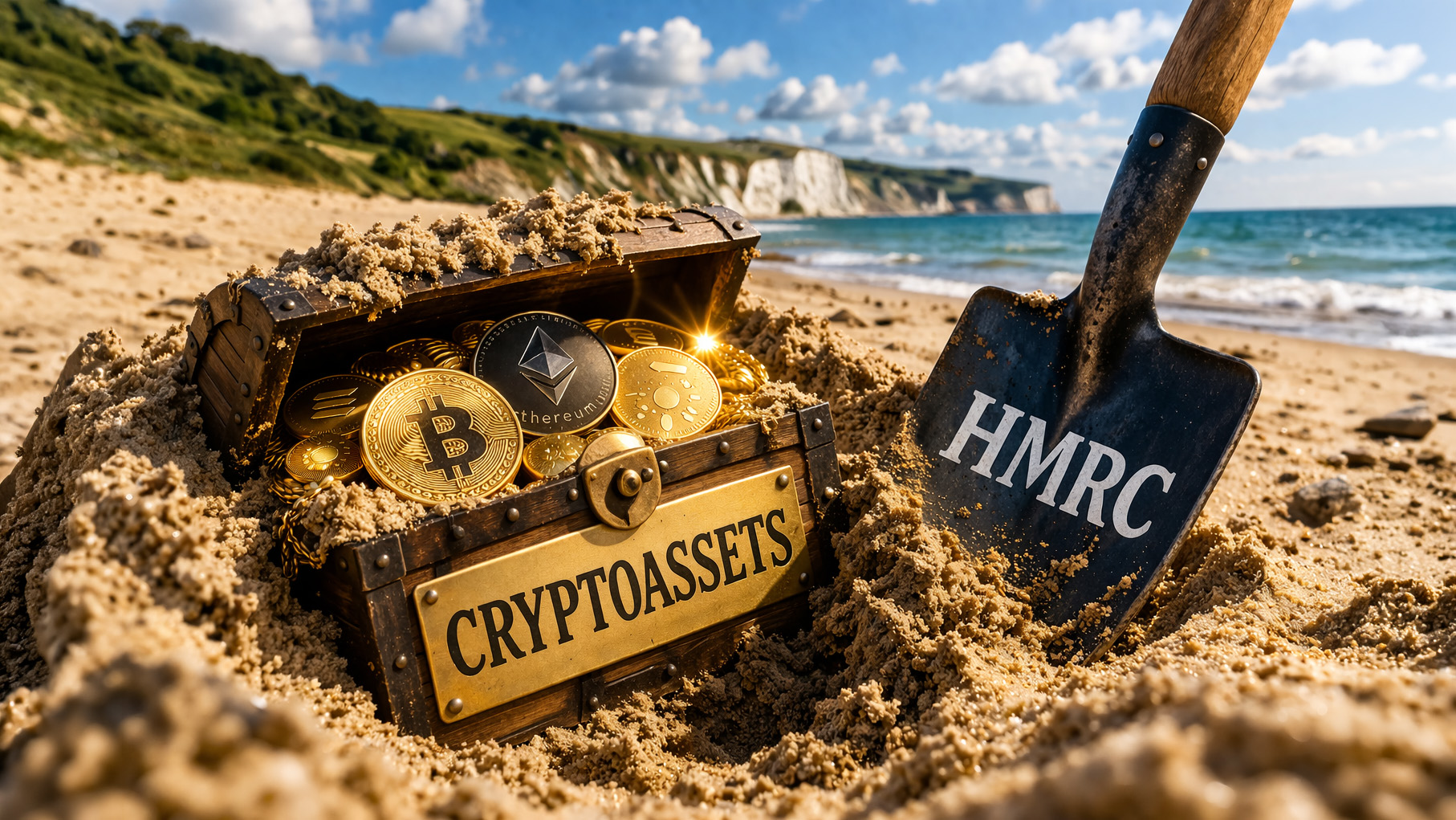
Following recent developments, HMRC will soon have access to information on many cryptoasset holdings, and is taking the opportunity to issue a reminder that these need to be reported as part of taxable estates.
A letter from HMRC

HMRC recently sent a letter to professionals who have previously submitted Inheritance Tax returns, reminding them that cryptoassets are subject to Inheritance Tax (IHT). The letter instructs recipients to check whether estates include cryptoassets, and to make sure they are reported to HMRC as part of a return. Where submitted returns have failed to mention a cryptoasset belonging to the deceased, HMRC point out that this must be amended.
When are cryptoassets subject to IHT?
Under the rules that apply to deaths since 6 April 2025, IHT is charged on all assets of a person who dies as a Long Term Resident of the UK, which means they have spent at least 10 of the last 20 years as a UK tax resident. (A year of residence for these purposes is determined by the UK’s Statutory Residence Test.) Those who are not Long Term Residents will only be subject to IHT on their assets located in the UK.
Of course, this rule is not so straightforward to apply to decentralised cryptoassets, which can’t really be said to have a ‘location’ in any meaningful sense. There are various different arguments that can be made for how their legal location can be identified in English law. HMRC have advanced their own theory (albeit one without much legal basis or support from professionals or academics) that this is based on the residence of the beneficial owner of the cryptoasset.
This can lead to some surprising results. Imagine an Italian with cryptoassets held by a Swiss custodian, who decides to spend a few years in the UK. She has been advised that her foreign assets are not subject to IHT until she has spent at least 10 years in the UK, and so assumes that her cryptoassets are currently exempt from IHT. However, if she dies two years after arriving in the UK, HMRC would take the view that because she was UK resident, the cryptoassets are UK assets, and therefore subject to IHT. Of course, had she been properly advised, our Italian cryptoholder would ideally have undertaken pre-arrival planning to mitigate this potential exposure to IHT.
The CARF
At first glance, it is not obvious what has prompted this reminder from HMRC, since the law on this point has not changed. As HMRC point out, while there is no specific reference to cryptoassets in IHT legislation, the wording in the Inheritance Tax Act 1985 is certainly broad enough to apply to cryptoassets.
Perhaps the reason for this letter is the introduction at the start of this year of the Crypto-Asset Reporting Framework (CARF) in many jurisdictions, including the UK. The CARF is an international agreement for information sharing, similar in some ways to the Common Reporting Standard (CRS). The idea behind the CARF is that cryptoasset service providers (such as exchanges, for example) will be obliged to identify their customers and collect certain information about their activities (for example, sales and purchases of cryptoassets) so that this can be shared with the tax authorities wherever the customer is resident.
This additional transparency may bring unwelcome surprises for those who have either assumed that they did not have to pay tax on cryptoassets, or believed HMRC would never find out. If the CARF data suggests a person had been selling cryptoassets at a gain, and they failed to report that gain to HMRC, it is likely that HMRC will have further questions. Similarly, if HMRC knows from CARF that a person was investing in cryptoassets, and their personal representatives submit an IHT account that fails to disclose these, we expect that HMRC will get in touch.
Difficulties identifying cryptoassets
Of course, it’s one thing to know that cryptoassets need to be declared for IHT purposes, and quite another for personal representatives to know whether a deceased person owned them, or indeed find out the quantities and types of token that were owned. If the deceased did not leave accessible records, it may be difficult if not impossible to identify their cryptoassets. It’s easy to imagine that in many cases, a CARF-prompted enquiry from HMRC might be the first clue many personal representatives may have that there are cryptoassets in an estate.
Even where a deceased’s cryptoassets can be identified, that does not mean that personal representatives will be able to realise their value. For cryptoassets held in the deceased’s own custody (rather than, for example, held by an exchange or other custodian), the personal representatives will not be able to make a sale or transfer unless they can discover the private keys. This does lead to the possibility of a worst-case scenario where the personal representatives and HMRC know that there are cryptoassets in the estate, and HMRC are asking for tax, but the assets cannot be sold to pay it.
What should you do?
This illustrates well the importance of succession planning for those with cryptoassets. A Will by itself is not enough; you also need to ensure you have a system in place for your personal representatives to be able to identify your assets and also access the necessary private keys. This is a complex topic, and there are a variety of different solutions that might be appropriate in different circumstances, but the Private Wealth and Tax team at Quastels is well-qualified to be able to advise.