International Buyers Hub

Residential Real Estate

International Buyers Hub

Purchasing a property in the UK from overseas? Here is everything you need to know about the UK legal process, things you should consider, and how we can help you.

Still have questions?

Contact

International Buyers Hub

An Introduction to our International Buyers Hub

Buying residential property in the UK from overseas comes with unique legal, financial and practical considerations. Our International Buyers Hub brings together clear guidance, practical tips and expert insight to help you navigate the UK property process with confidence – whether you’re purchasing a home, an investment property, or planning for the long term.

International Buyers Top Tips

5 Considerations When Purchasing a UK Property from Overseas

Purchasing a property from overseas can be complex, as the legal process in the UK may differ significantly from that in your home country. At Quastels, we aim to make buying UK property from abroad as straightforward and stress-free as possible. Here are our five top tips to help guide you through the process:

Tip 1: Understanding the UK Legal Process

It is important to be aware that your offer is not legally binding until contracts are exchanged. During this time, your solicitor will carry out important due diligence on the property documentation, including:

  1. Reviewing the title documents to confirm the seller has the right to sell.
  2. Identifying planning permissions, environmental risks, or nearby developments which may affect your enjoyment of the property.
  3. Checking planning and building compliance for any past works.
  4. Identifying restrictive covenants, rights of way, or registered charges against the property.

Once the legal checks are complete, your solicitor will report to you on the property and highlight any legal issues to address before you move forward.

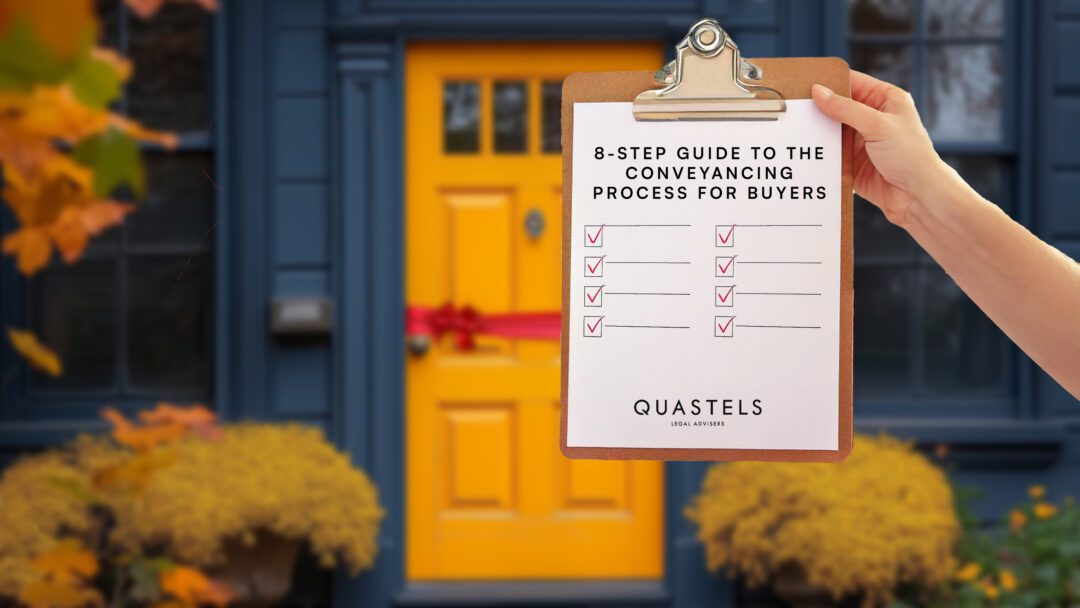
A person holds a clipboard in front of a vibrant yellow front door decorated with a red ribbon. The clipboard displays a checklist titled "8-Step Guide to the Conveyancing Process for Buyers" with all eight items checked off. Autumn leaves and potted yellow flowers are visible around the doorway, suggesting a cozy, welcoming home. The bottom of the checklist reads "QUASTELS Legal Advisers.
Featured Content Apr 11, 2025
An 8-Step Guide to the Conveyancing Process for Buyers

For first-time buyers and seasoned property owners, the conveyancing process can be rather daunting and complex. This 8-step guide to…

International Buyers Top Tips

Tip 2: Choosing the Right Solicitor

It is essential to work with a solicitor who is experienced in assisting international clients purchase property in the UK. Clear communication across time zones is essential to keeping your purchase on track.

Look for a firm that offers flexible ways to stay in touch (such as WhatsApp or WeChat for quick updates) and uses modern technology to simplify the process. Tools like Smartsearch for online ID verification and DocuSign for digital document signing mean you can complete most of the transaction remotely, without needing to travel to the UK.

Docusign Guide for Quastels Clients
Featured Content Feb 24, 2025
Docusign | How-To Guide

During the conveyancing process, your solicitor/conveyancing executive will ask you to sign a document(s) using Docusign. Below is a simple…

International Buyers Top Tips

Tip 3: Plan Your Funding

Before your solicitor can proceed, they are legally required to verify both your identity and the source of your funds under UK anti-money laundering regulations. You’ll need to provide clear evidence of where your money has originated from, for example:

  • Savings
  • Investments
  • Sale of a business
  • Sale of another property
  • Family gift

If you’re buying with a mortgage, it’s important to use a broker familiar with overseas clients. UK lenders often have specific requirements for non-residents, and an experienced broker can help secure a product suited to your situation. At our firm, we work closely with specialist mortgage brokers who regularly assist international buyers.

You should also plan ahead for international money transfers, taking into account exchange rates, banking timelines and any restrictions in your country of residence. A proactive approach helps avoid unnecessary delays when it’s time to exchange and complete.

International Buyers Top Tips

Tip 4: Consider Tax Implications

Tax planning should start before you buy. Most property purchases in England and Wales are subject to Stamp Duty Land Tax (SDLT), with a 2% surcharge applicable for non-UK residents.

Our in-house Private Wealth & Tax team can advise on:

  • Calculating SDLT and any available reliefs.
  • Structuring your purchase efficiently, for example personal ownership vs company ownership.
  • Capital Gains Tax on future sales.
  • Inheritance Tax considerations for overseas owners.

Early planning helps you avoid unexpected costs later. View our Private Wealth & Tax services here.

The image shows the transition from tourist to taxpayer. On the left, the man is seen in front of the Houses of Commons, wearing an I heart London t-shirt. On the right, the man is wearing businesswear and is in an office, showing he now has been in the UK long enough to hold UK tax residence.
Featured Content Jul 15, 2024
Tourist Today, UK Taxpayer Tomorrow?

UK tax residence goes beyond simple day counting, and it is important for individuals to carefully observe time spent in…

International Buyers Top Tips

Tip 5: Use a Full-Service Approach Firm

Buying a property from overseas can feel complex, but with the right support, it can be a smooth and well-managed experience.

We offer a full-service approach, designed to make every step easier. This includes:

  • Multilingual support, ensuring clear communication wherever you are based.
  • Introductions to trusted surveyors, mortgage brokers, interior designers, and project managers, giving you access to a complete professional network for your property purchase and setup.
  • In-house tax and immigration advice, helping you explore tax issues and investor visa options or residency routes linked to property ownership.
A stern-faced immigration officer in a dark uniform extends his hand while holding a passport at an airport checkpoint. The modern, well-lit background suggests an official setting. The image visually supports the theme of "Key UK Immigration Updates for 2025: What You Need to Know," highlighting authority, regulation, and entry procedures.
Featured Content Apr 15, 2025
Key UK Immigration Updates for 2025: What You Need to Know

In 2025, the UK government remains focused on refining its immigration framework, prioritising skills-based immigration, streamlining application processes, and strengthening…

Woman in airport holding child's hand between Hong Kong and the UK

Frequently Asked Questions

I am happy to proceed. What do you need from me to start the process?

To initiate the conveyancing process, we need the final terms of sale, often referred to as the sales memo, from your estate agent or the reservation form detailing the terms of your transaction. Once we receive this information, we will create your file and guide you through the initial steps, which will include you providing us with a copy of your passport, proof of address, and source of funds information.

How long does the conveyancing process take?

The duration can vary based on several factors, such as the property type, any chain involved, and local authority processes. National averages are many months, but we will aim for between 6 to 12 weeks, it may be longer in complex situations.

Does your retainer include tax advice?

We will provide details of the Stamp Duty Land Tax that is payable. We have a dedicated Tax Team that can assist you with further specialist enquiries as may be necessary.

I have agreed an incentive with my seller. How does this work?

Any financial incentive will be deducted from the final balance due to the seller, and addressed in their completion statement. For example, if the seller has agreed to contribute to your legal fees, they will deduct that amount from the final balance we send to them.

Why do I need to make an upfront payment for legal fees?

We ask for an on-account payment, typically between £1500-£2000. This is so we have funds to pay for any necessary property searches and also a commitment from you for us to start work and incurring time. This sum will be credited towards your invoice, there is no element of double-charging.

If I do not proceed and withdraw, what will I be charged?

If you decide to withdraw early in the process, we typically won't charge you anything. However, if significant work has already been undertaken, we will charge you based on the amount of time incurred. This would not usually exceed any fixed fee.

Do you recommend I use a surveyor?

Yes, we strongly recommend using a surveyor, even when purchasing a new build property. A survey can identify defects or issues that need addressing before you finalise your purchase. You must arrange any survey before the exchange of contracts so that any findings can be raised with the seller, allowing for negotiations or repairs to be arranged as part of your transaction.

When should I apply for a mortgage?

You should check with your mortgage broker how long the mortgage process is likely to take. If you are buying a finished property, you must have your mortgage offer before you exchange contracts and commit to the purchase. If you are buying off-plan, it is advisable to speak with a mortgage broker early in the process to understand your options and get pre-approval before committing to the purchase.

What is the difference between freehold and leasehold properties?

A freehold property means you own the property and the land it stands on outright, giving you full control. In contrast, leasehold means you own the property for a specific period but not the land. You may need to pay ground rent and service charges. Leasehold property will generally have more restrictions. Our report to you will summarise relevant restrictions.

What happens on completion day?

On completion day, the buyer's solicitor transfers the final payment to the seller’s solicitor. On receipt of the funds, the seller's solicitor dates the legal transfer, which has been signed by the seller, and contacts the selling agent to release the keys. You will usually be able to obtain the keys at about 1pm. The seller's solicitor will send the transfer to the buyer's solicitor, who will then deal with the land registration.

Still have a question? We're here to help.

Didn't find the answer you were looking for? Send us your question and one of our experts will get back to you.

Consent(Required)

Insights

Related Content

trusted legal excellence

Get in Touch

Contact us today to discover how we can support you with legal solutions that stand out from the rest.

Get in Touch