First Time Buyers Hub

Residential Real Estate

First Time Buyers Hub

Purchasing your first home is a huge achievement. There is a set conveyancing process for the purchase of properties in the UK. This page is designed to tell you everything you need to know about the process.

Still have questions?

Contact

Purchasing Your First Property

The Conveyancing Process

Purchasing your first property is a significant milestone. The process involves a series of rules and requirements set out by the UK Government. In this guide, based on years of experience in acting for first-time buyers, we will explain what you need to know about purchasing your first home– covering the key steps involved, what documents you should have prepared, and key things to keep in mind as you move forward.

Our experienced Quastels Residential Real Estate team has helped countless individuals navigate this journey smoothly, and we aim to provide you with the insights and tips to make your purchase as straightforward and stress-free as possible.

Key Steps in the Conveyancing Process

  1. Onboarding and Background Checks: We will conduct onboarding procedures, which include necessary background checks. This step involves verifying the source of funds, a legal requirement before proceeding with any property transaction.
  2. Contract and Title Review: Once background checks are clear, we will review the contract and title documents to ensure that there are no issues or discrepancies that could affect your purchase. We then report to you on the title and provide you with the related documents we have reviewed.
  3. Exchange of Contracts: This pivotal stage involves the formal exchange of contracts, at which point you will pay your deposit. Once contracts are exchanged, the agreement becomes legally binding, and both parties are committed to the transaction and a completion date is set for you to collect your keys.
  4. Pre-Completion: You will receive a completion statement from your solicitor, breaking down all funds received (e.g. funds on account received from you) or to be received (e.g. mortgage advance, if applicable), all funds paid out (e.g. searches) and to be paid out (e.g. Stamp Duty Land Tax). It will show the balance due from you in order to complete the transaction. Your solicitor will draw down your mortgage funds for the agreed completion date.
  5. Completion: On completion day, ownership of the property officially transfers to you. We will pay the final balance to the seller on your behalf, and you will receive the keys to your new home.
  6. Post-Completion: After completion, you will be responsible for paying any applicable Stamp Duty Land Tax. We will handle the submission of this tax and registration of your ownership with the Land Registry to ensure that your title is officially recorded in your name.

Download our brochure for off-plan purchases

Find out more about our language capabilities, key contacts, and fees.

We'll use your email to deliver the content you've requested. For details on how we handle your data, please see our Privacy Policy.
By entering your email, you’ll be automatically added to our mailing list.

globe

AML Checks

In order to be onboarded as a client and to complete your property purchase, you will have to undergo Anti-Money Laundering checks. For this we will require evidence of ID (such as a passport), and proof of income (such as a recent bank statement). You will have the option to complete your ID checks in person at our office, or online via SmartSearch. If you choose to use SmartSearch, you will receive a link via text or email. It will ask you to take photographs of your ID (passport, valid driving license, or ID card), and then take a photo of yourself (it is advised to use your mobile for a better quality photo in order to avoid delays). Once you have completed these steps, SmartSearch will notify us that this has been completed.

The Reporting Stage

This stage is where the bulk of the legal work takes place. Your solicitor will provide you with key information about the property, your contract, and lease searches. It is vital that you contact your solicitor with any questions you have after receiving your reporting information, as once you exchange contracts, your purchase becomes legally binding. Ensure at this point that you have a mortgage in place (prior to exchange), you can contact us for recommendations for people who may be able to help.

Provided you’re happy, you would sign the contract and our report (as a sign that you have read all contents), send the signed documents back to us and then transfer the inital deposit to our client account. If the property build is complete, you would request a completion date at this point, if not, you’d proceed to exchange of contracts.

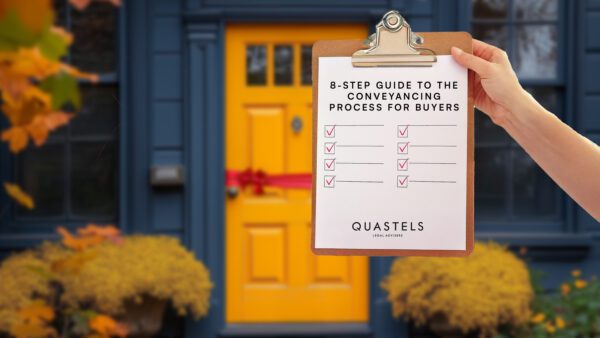
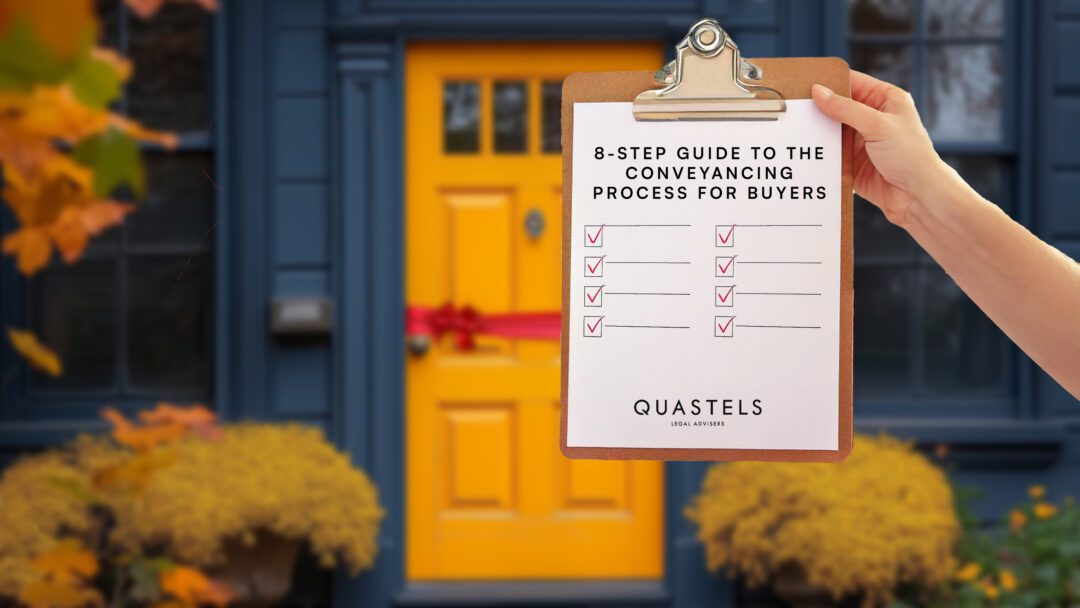
A person holds a clipboard in front of a vibrant yellow front door decorated with a red ribbon. The clipboard displays a checklist titled "8-Step Guide to the Conveyancing Process for Buyers" with all eight items checked off. Autumn leaves and potted yellow flowers are visible around the doorway, suggesting a cozy, welcoming home. The bottom of the checklist reads "QUASTELS Legal Advisers.
Featured Content Apr 11, 2025
An 8-Step Guide to the Conveyancing Process for Buyers

For first-time buyers and seasoned property owners, the conveyancing process can be rather daunting and complex. This 8-step guide to…

Kiah-1-scaled

Local Searches

Property searches are investigations conducted to uncover important information about the property, such as planning permissions, local authority notices, and environmental risks. These searches are crucial as they help identify potential problems that could affect your decision to proceed with the purchase. You don’t have to order searches if you are purchasing without a mortgage, but best practice recommends you do so. Searches do not involve a physical inspection, and therefore we advise that you organise a survey to take place before exchange of contracts.

Frequently Asked Questions

I am happy to proceed. What do you need from me to start the process?

To initiate the conveyancing process, we need the final terms of sale, often referred to as the sales memo, from your estate agent or the reservation form detailing the terms of your transaction. Once we receive this information, we will create your file and guide you through the initial steps, which will include you providing us with a copy of your passport, proof of address, and source of funds information.

How long does the conveyancing process take?

The duration can vary based on several factors, such as the property type, any chain involved, and local authority processes. National averages are many months, but we will aim for between 6 to 12 weeks, it may be longer in complex situations.

Does your retainer include tax advice?

We will provide details of the Stamp Duty Land Tax that is payable. We have a dedicated Tax Team that can assist you with further specialist enquiries as may be necessary.

I have agreed an incentive with my seller. How does this work?

Any financial incentive will be deducted from the final balance due to the seller, and addressed in their completion statement. For example, if the seller has agreed to contribute to your legal fees, they will deduct that amount from the final balance we send to them.

Why do I need to make an upfront payment for legal fees?

We ask for an on-account payment, typically between £1500-£2000. This is so we have funds to pay for any necessary property searches and also a commitment from you for us to start work and incurring time. This sum will be credited towards your invoice, there is no element of double-charging.

If I do not proceed and withdraw, what will I be charged?

If you decide to withdraw early in the process, we typically won't charge you anything. However, if significant work has already been undertaken, we will charge you based on the amount of time incurred. This would not usually exceed any fixed fee.

Do you recommend I use a surveyor?

Yes, we strongly recommend using a surveyor, even when purchasing a new build property. A survey can identify defects or issues that need addressing before you finalise your purchase. You must arrange any survey before the exchange of contracts so that any findings can be raised with the seller, allowing for negotiations or repairs to be arranged as part of your transaction.

When should I apply for a mortgage?

You should check with your mortgage broker how long the mortgage process is likely to take. If you are buying a finished property, you must have your mortgage offer before you exchange contracts and commit to the purchase. If you are buying off-plan, it is advisable to speak with a mortgage broker early in the process to understand your options and get pre-approval before committing to the purchase.

What is the difference between freehold and leasehold properties?

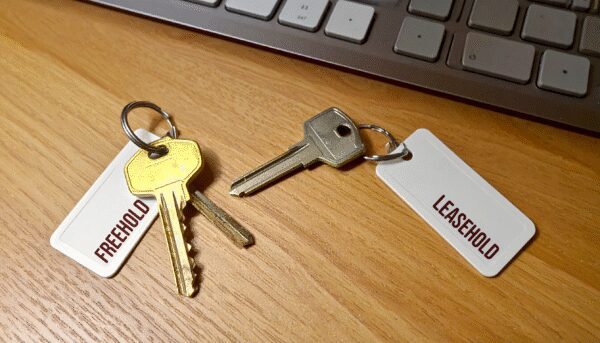
A freehold property means you own the property and the land it stands on outright, giving you full control. In contrast, leasehold means you own the property for a specific period but not the land. You may need to pay ground rent and service charges. Leasehold property will generally have more restrictions. Our report to you will summarise relevant restrictions.

What happens on completion day?

On completion day, the buyer's solicitor transfers the final payment to the seller’s solicitor. On receipt of the funds, the seller's solicitor dates the legal transfer, which has been signed by the seller, and contacts the selling agent to release the keys. You will usually be able to obtain the keys at about 1pm. The seller's solicitor will send the transfer to the buyer's solicitor, who will then deal with the land registration.

Still have a question? We're here to help.

Didn't find the answer you were looking for? Send us your question and one of our experts will get back to you.

Consent(Required)

Why Choose Quastels?

We are particularly well-known for expertise in advising UK and overseas buyers on new-build properties, plot sales and portfolio refinancings. Across our team of conveyancing solicitors and executives we have a range of language skills (including Cantonese, Mandarin, Hindi and Turkish) and act for a wide range of clients. We are accredited under the Law Society’s “Conveyancing Quality Scheme.”

We understand the importance of speed and decisive action. Our commitment to getting things done efficiently and purposefully extends to offering electronic signing of documents, where permissible, as well as international language capabilities and transparent legal fees for all matters.

Importantly, we pride ourselves on our skill in communicating well. Our clients trust us to solve problems and provide clear, supportive guidance, whatever the challenges presented. Drawing from across the firm our conveyancing solicitors & executives are able to deliver the very best, complete service, ensuring our clients are protected, guided and supported throughout the process.

A couple stands in front of their new home with two piles of boxes on either side. The boxes are labelled 'joint tenancy' and 'tenancy in common' to reflect the types of property ownership.
Featured Content Aug 8, 2025
A Simple Guide to Property Ownership Options When Buying With Your Partner or a Friend

What are Joint Tenants? Holding the property as joint tenants means that each person has an equal interest in the…

Insights

Related Content

trusted legal excellence

Get in Touch

Contact us today to discover how we can support you with legal solutions that stand out from the rest.

Get in Touch